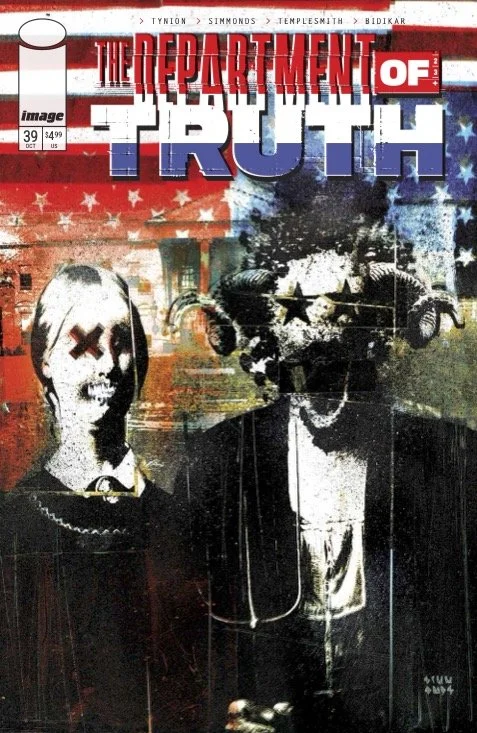
The Department of Truth #39 // Review
Bob’s a nice guy. He’s a mail carrier for the U.S. Postal service. He lives alone. He recently tried to get in shape. He recently tried a dating app. He’s got a pretty solitary life, but it’s pretty stable. That’s all about to change in The Department of Truth #39. Writer James Tynion IV and artist Martin Simmonds work their way through a story of a reluctant participant in the world of shadows that takes a rather deep dive into the psyche of a large swath of the U.S. n an era of increasing intensity between different ends of the culture war.
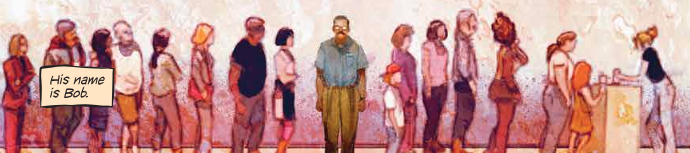
Ruby has been asked to speak with the Lee Harvey Oswald. She's upset. He knows about it. Naturally she's going to ask him what the story is. And she's going to tell him. And what she is going to tell him it has to do with a guy named Bob. Perfectly normal guy. Lived in a small town that was being increasingly inhabited by people from outside of the country. Bob didn’t seem to mind. Bob wasn't supposed to get involved in anything. Somewhere in the midst of it all, Bob finds himself in the presence of government agents.
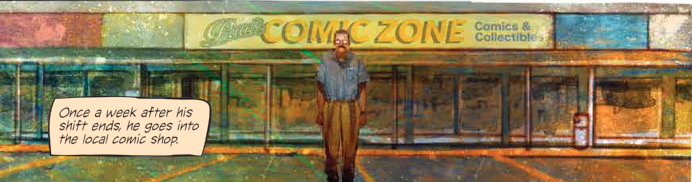
Tynion dives into Replacement Theory from an angle that fuels are relatively fresh and original. All too often the dark conspiracy theories, and the horror stories that outline them lack the presence of people who simply don't engage in such things. They're always around in the periphery to be victims. Tynion focus is an entire issue on one guy. It's an extended character sketch of someone living in the nightmares world of the series completely without any significant interest in it. It’s a well-constructed one-shot story that fits perfectly into the larger picture of the overall series.
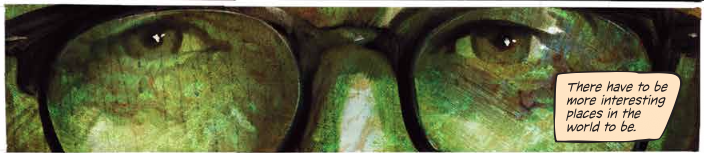
Simmonds handles the mundane nature of Bob’s life without over-exaggerating anything. It might have seemed that much more visually impressive, or the artist to try to create more of a contrast between the world of darkness and the world of Bob. That would have come across this kind of a cheap way to engage in the story, though. Instead, Simmonds captures the life of Bob through a series of panels that I might as well be very uninviting Polaroids. It is actually kind of a hypnotic effect. The life of Bob is captured in a very succinct and straightforward sentences. The visual reality of what's being brought to the page matches this tone almost perfectly.

Tynion has largely been moving around the edges of the vast majority of the Americans who are really at the heart of the story. The world of the series focuses so much. I'm concerns over popular opinion and how that shifts reality. But it's not very often that the series has lingered for a very long on those characters, most likely to be influenced by popular opinion. Once again, Tynion and Simmonds deliver a story that could really serve as the first issue for a lot of people. Though there's clearly a lot of background that plays into the one shot story, it is something that could be right entirely on its own and still have the same thematic weight.