

Review of Jeff Pearlman’s Only God Can Judge Me: The Many Lives of Tupac Shakur
I had just turned fifteen years old when Tupac was killed. I’ll never forget where I was. It was a Friday night after losing a football game. I didn’t play much at that time, but I was still disappointed since we lost to our arch rival, who had a reputation for being a pretty racist team. I got in the car and found out from my mother that my great aunt Laura had just passed away earlier that day after health issues caused by a brain aneurysm. Then came the final blow. My cousin, who was also in the car, said “you know Tupac dead right?” I said “No he ain’t. You playing,” and she said “nuh uh, he dead.” They announced it on the radio earlier today.”
Boom. The trifecta. A loss to our racist rival, my aunt dying, and Tupac. As sad as I was about my great aunt passing, I spent more time with Pac. At least that’s what it felt like listening to his music. I loved West Coast rap, as did much of the South. Snoop was my guy. Doggystyle, Murder Was the Case, Dogg Food by the Dogg Pound. Snoop was my guy. But Pac. We LOVED Tupac. He showed us a depth we rarely got from rappers back then.
I related to Pac on a personal level. Every song fit a mood. Pac was rampage and reflection, an expression of the side of me that didn’t get to come out as much because I lacked his confidence, and because I grew up in a drastically different environment. I never saw contradictions. I saw different moods and emotions. I was too young to name it then, but I felt it. This is a long way of saying that Tupac had a profound impact on me, more than any other artist. So when I discovered that Jeff Pearlman was writing a book on Tupac, I was surprised and intrigued. I already followed Jeff for his sports stories, so this was unexpected. I saw videos of Jeff talking about his work on the book, and I committed to buying it. I did. I wasn’t looking for an idealistic portrait of a fallen hero. I’m old enough now to recognize that Tupac was a flawed figure whose life was built on passion, trauma, brilliance, and mistakes. I went into this looking for a thoughtful and honest attempt to understand a complicated icon.
The Challenge of Writing About Tupac
Jeff Pearlman had a difficult task ahead of him writing about Tupac. Doing anything Tupac related is hard because Pac is so iconic, and it’s almost impossible to fully capture the varying aspects of his dynamic personality.
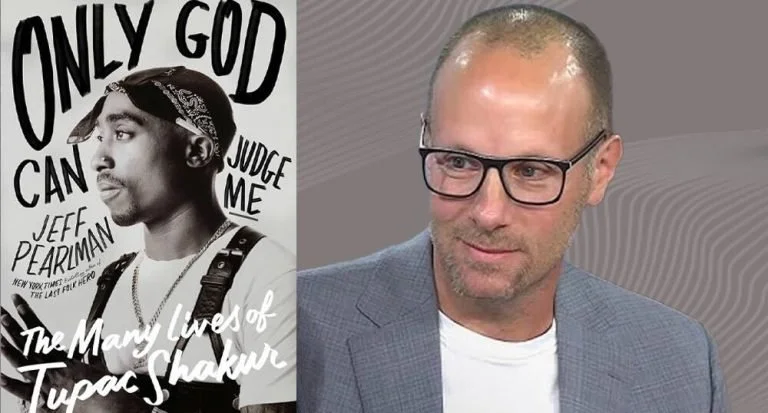
I’m not sure Jeff was fully aware of what he was stepping into. Black people are protective of their icons, and hip hop fans are often the most aggressive and outspoken part of the Black community. Tupac fans are often the most loyal of the loyalists, even after all this time. Tupac also created multiple versions of himself, and those versions all feel real to different groups of people. Jeff stepped into hip hop culture from the outside and attempted to write about one of the most important cultural figures of the last forty years. There was always going to be skepticism and a level of mistrust as people wondered what the motives were for a middle aged white man writing about Tupac. Not everyone who approaches Black icons does so with good intentions, and we’re used to people attempting to diminish their legacy. Sometimes it’s deserved, but other times it’s done with malice.
There’s also the reality that, despite how loved Tupac is, he remains a polarizing figure. Click on any comment section on YouTube, Facebook, or TikTok and you’ll see everything from unbridled admiration to hate that feels personal. I can’t tell you how many times I’ve seen white guys commenting, often fueled by the lies of Candace Owens calling Tupac gay, or a fake gangster, or a phony. Things like this, these actions and behaviors, have strengthened the belief among some in the community that the culture needs gatekeeping.
So I don’t envy the position Jeff put himself in. I do admire the desire, curiosity, and determination required to see this task through. I’m not sure this book will win him trust across the board, but the book may have a lasting impact on Tupac’s legacy going forward.
What the Book Gets Right
The book does a good job of illuminating details of Tupac’s upbringing that even hardcore fans may not have known. We all knew Tupac grew up in poverty, and that his mother Afeni had a drug problem. But the book provides intimate details about what that looked like day to day.
It shows how lost Afeni was to addiction. Someone who was so strong in her beliefs was weak when it came to battling drugs. Her children had no structure, no guidance, and weren’t protected like they should have been. Both Tupac and his sister experienced abuse and sexual assault. Tupac himself was taken advantage of as a child by one of Afeni’s friends, an adult woman. Tupac and his sister often had to fend for themselves.
And yet, you still see Afeni’s teachings in Tupac, and how they shaped his thinking and his music. The book highlights the tension between Tupac and his mother. You can hear in the accounts that this was someone who wanted to look up to her, he did, but for a long time it was overshadowed by resentment caused by her addiction and her failure to be the mother he deserved.
You can’t help but feel for the young Pac as he had to navigate life with no father and essentially no mother. Tupac’s song “Part Time Mutha” takes on a new meaning after reading this book. The book paints a vivid picture of instability, poverty, political radicalism, and community pressure shaping the future rap star. It’s strongest when covering Tupac’s early life.
Where the Book Struggles
The book shows Tupac’s complexity, but there are issues with the narrative framing. One repeated phrase was “he wasn’t that guy.” It was stated by people Jeff interviewed, and echoed by Jeff. Over time it starts to feel like an underlying narrative that sets the tone.
Tupac was an actor. Tupac couldn’t shoot a gun. Tupac was a nerd. Tupac was a theater kid. Tupac wasn’t athletic. Tupac wasn’t. So what was he? The book doesn’t outright answer this, but the theme suggests Tupac was inauthentic. At one point I remember saying out loud, Tupac was everything and could have been anything. And parts of the book, or Pac’s actions rather, directly contradict the idea that he was faking it. It talks about him never backing down and being extremely brave. But at times it paints a picture of someone who was none of those things. It leads you to believe that when he did bold and bombastic things, those things weren’t him.
This is where context matters. If you’re African American, especially in professional spaces, you understand the necessity of code switching. Many of us do this because presenting a certain face means adapting to be accepted or tolerated. Most of us do it in white or professional environments. Tupac code switched in whatever environment he was in. He did it on the extreme. He wanted acceptance, but he was also all of these people. So how much do you have to show to be taken seriously? Why is Tupac denied this in the book.
At times the book treats his shifts almost as a type of fraud, when many Black readers will see them as survival. The example everyone knows is Tupac shooting the two off duty cops in Atlanta while defending a Black motorist. It’s mentioned, but it’s not analyzed as part of his character. No one asks how that moment fits into who he was. We’re left to piece that together, while other moments are used to clearly say he wasn’t that guy.
The book often goes from one bad or chaotic moment to the next. After a while it almost feels like the narrative revels in the chaos. To be fair, Tupac had a short but very eventful life. Many of these events were public. But the book also talks about private conversations, and many of those still show a hyperactive, unpredictable, volatile guy. That was part of Tupac’s personality, but Tupac was both fire and focus. I would’ve liked more of the reflective moments. There are a few. A story from high school with an ex-girlfriend. A conversation about running for office. But we didn’t get a lot of the Tupac that many of us knew existed. I don’t think this is all the author’s fault. I don’t know how many stories were told to him, and how many, if any, were cut. I also know many people refused to talk to Jeff, so those voices are missing.
The Allegations
One of the most disturbing parts of the book was the section dedicated to Tupac’s sexual assault allegations. Before talking about this, I want to say clearly that my respect for Tupac doesn’t override my principles. As a husband, a father, and a son, and professionally as a lawyer who previously worked as an investigator in the criminal justice system, I take sexual assault seriously. I’m not discrediting anyone, and I’m not attacking anyone. I’m giving my honest reaction and my personal standard.
The book addresses the well known sexual assault accusation made by Ayanna Jackson in 1994. There’s a lot of lore and myth around this, as well as anger and resentment. I’m familiar with this accusation. The book goes into what happened that night, and it gives Ayanna Jackson’s voice the weight it deserves.
But as someone who knows a good deal about the case, there were things that could’ve been explored more. There are circumstances around why Tupac believed he was set up. There are questions about whether the alleged victim knew one of the men involved. I understand why a writer avoids opening that door, because casting doubt on victims has a long history of silencing their voices. But if there’s one thing that should’ve been included, it’s Tupac’s voice. This is a book about him. His account is mentioned but his voice is missing.
Tupac’s role in this is not a good one either way. At worst he was complicit in a rape. At best he was irresponsible. Even if you believe his account that she seemed to be enjoying it when the other men entered and that’s why he left, it was still massively irresponsible.
The book also reveals another allegation from a few months prior. Jeff spoke to the alleged victim. Some people are angry that it was included at all. I’m not. If you’re a journalist, your responsibility is to truth. But the framing is designed to paint a picture of consistency. That may or may not be fair. You can judge that yourself.
According to the accuser, the account is similar in that Tupac, who often invited others to participate in group sexual activities, think “Ain’t No Fun” by Snoop, coerced this girl back to his room, coerced her into having sex, and she complied because she was afraid. Then allegedly he tried to get her to have sex with his friend, and when she didn’t, he ordered the other person to take her back to where she was. While on the way back, the other person forced her. There was a police report and a rape kit. According the book the DA refused to prosecute because they felt they couldn’t make the case since she didn’t attempt to get away. According to a 2024 interview with former Los Angeles detective Greg Kading, and the author of Murder Rap, the alleged victim chose not to continue forward and thus the case was closed due to insufficient evidence. As with many things, no one knows what the truth actually is.
After reading, I was uncomfortable and sat with it in silence for ten minutes. My principles knocked my fandom down. I read that section a second time with my fandom put away. My personal mantra is simple. One thing I’ve learned personally is to never accept any one account as unquestionable fact. Again, this is not to discredit the alleged victim. That’s not what I’m doing here. But I’ve investigated murder cases, sexual assault cases, read police reports, seen video contradict reports, and watched both perpetrators and victims lie. I take sexual assault seriously. I give weight, consideration, and sympathy. But I don’t accept without convincing evidence. That’s my standard. This account leaves me with more questions than answers. We only hear one voice, and when something like this happens, you need a complete picture. We don’t have that. I don’t know what happened. I wasn’t there. One person who was there is no longer living. Others will take this and run with it. Others will reject it outright. Some will criticize me for not taking a strong position. That’s their right. My right is to say that I don’t know. That’s unpopular in a social media era that demands hot takes. But “I don’t know” is still a valid answer when you don’t have all the information.
Highlights & The Missing Voices
The book has touching and emotional stories that give insight into Tupac’s other sides. His reaction when Troy Dixon from Heavy D and the Boyz passed away in 1990. The story of finding the young man who inspired “Brenda’s Got a Baby.” He was adopted, then reconnected with his birth family, and they told him that song was about him. He had no idea. I got chills reading about his birth mother screaming with joy because they reconnected thanks to this book. These stories are highlights and I’m glad they were included and given room to breathe. They provided some of the balance I wanted more of.
The latter part of the book moves very fast, which is a shame since so much happens in his last year. But I chalk that up to people being unwilling to speak with Jeff. I imagine it was a trust issue. And that leads to my main issue. There were so many voices missing from this story. More of the Outlawz. Producers. The Dogg Pound. Kidada Jones, who as far as I know has never given an interview about Pac. Even people some might consider minor. For example, the woman who did the intro on “Me and My Girlfriend” has a TikTok where she tells Tupac stories all the time. Those stories matter too, because that’s where a lot of the culture actually lives.
I’m sure Jeff reached out to many of these people, he spoke with over 650, and still some refused for their own reasons. But that’s what happens when you don’t speak up. You allow others to tell the story for you. I don’t blame Jeff for them refusing, and I don’t blame them for being cautious when an outsider enters a space that’s deeply personal to the Black community. Regardless, it still feels like key voices are missing.
Lastly, I would’ve liked a deeper dive into the impact of Tupac’s music. The book touches on it, but we live in a time where there are thirty year olds who have no idea what Tupac’s music meant in real time. They don’t know how he was everywhere on the radio. They don’t know how songs like “Dear Mama” would play in neighborhoods and change the mood of an entire block. Showing the world around the music would’ve helped younger readers understand why Tupac mattered on that scale.
Final Thoughts
Some readers will leave this book thinking Tupac was a phony thug, a pretender, a monster, a talented artist, or an actor. Others will believe what he really was. A complicated individual.
Tupac was a product of his environment and a product of America’s racial oppression and economic neglect. He wasn’t a hero. He wasn’t a cultural icon because he was perfect. He was an icon because he was everything. He was aggressive and gentle. Protective of some women and disrespectful to others. He was a Black male born into poverty in the shadow of the civil rights and Black Power movement, to a crack addicted Black Panther, who rose to fame and became the most popular rapper in the world at the time of his death.
Tupac was both the American dream and an American tragedy, and I mean that in the truest sense of the word. Someone who grew up in an environment built for failure, but still found success, and was never given the tools to manage it.
This book makes that fact undeniable.