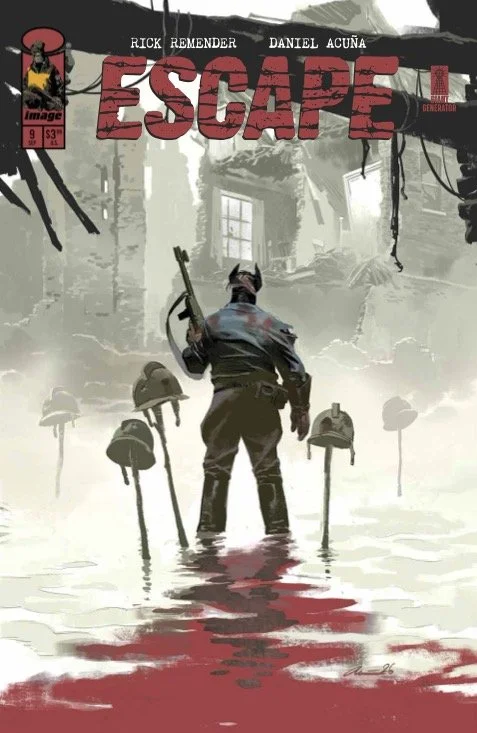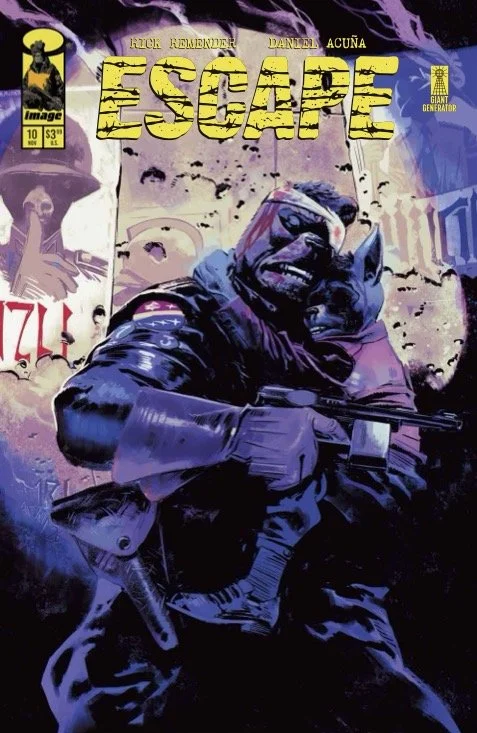
Escape #10 / Review
They're walking through the ruins of a war torn city. There doesn't seem to be any immediate danger. Whatever it was that went through came and left. There really isn't anything left. It’s all just wreckage and rubble. Their survivor is wandering through it all. And somewhere in the midst of it all, there's a joke. It's in slightly off color joke about a brothel and an inflatable woman. The people look for strangers things to get their minds off of their immediate surroundings in.Escape #10. Writer Rick Remender continues a World War II-style war drama with artist/colorist Daniel Acuña.

A joke resonates for a little bit. But authoritarianism and the wheel of the people and again: they're just talking about something to keep their minds off of where they are. Because if they think too much about where they are, they might start panicking. Things are stable, but they are tenuous. Before long, a knife will be fitted against a gun and a lead a pipe in the ruins of what had once been in the front line. Survival becomes a rather rather tricky proposition as tensions rise, a midst uneasy allies. Escape feels as distant as ever.
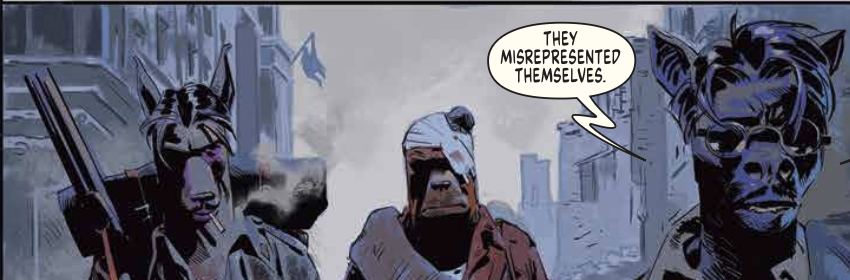
Remender balances the narrative quite a bit. There is a very even balance between verbal drama and physical action. The tension between a character, Whitfield as not for the fact that it's clearly a situation where they're walking through an empty battlefield with buildings that are completely demolished by a war that has affected their lies. And then there's the balance between low comedy and lofty questions. A somewhat off color joke, smoothly transitions to talks of totalitarianism and authoritarianism, and all of those things that lie at the heart of any ward drama. It's not just a clever balance. It's also a very sharp transition between moods, motions, emotions, and larger themes.
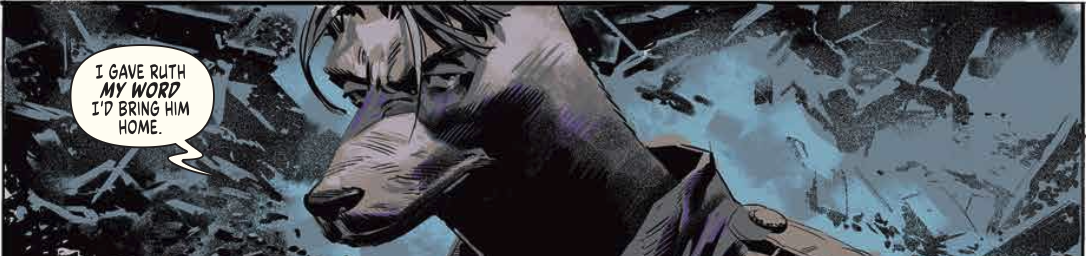
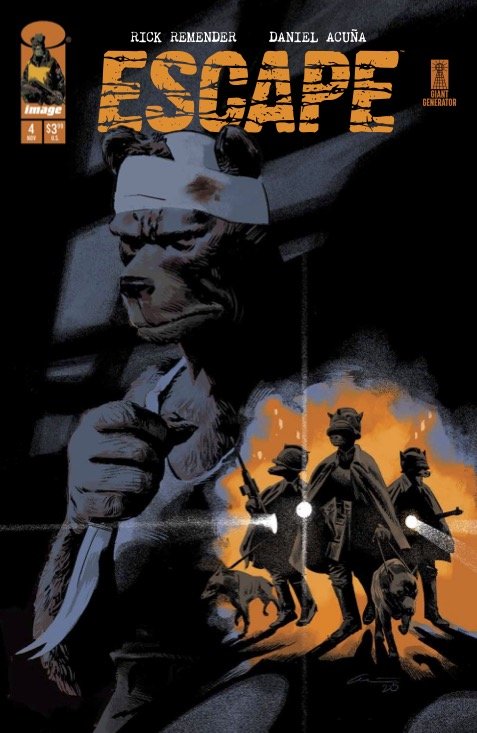
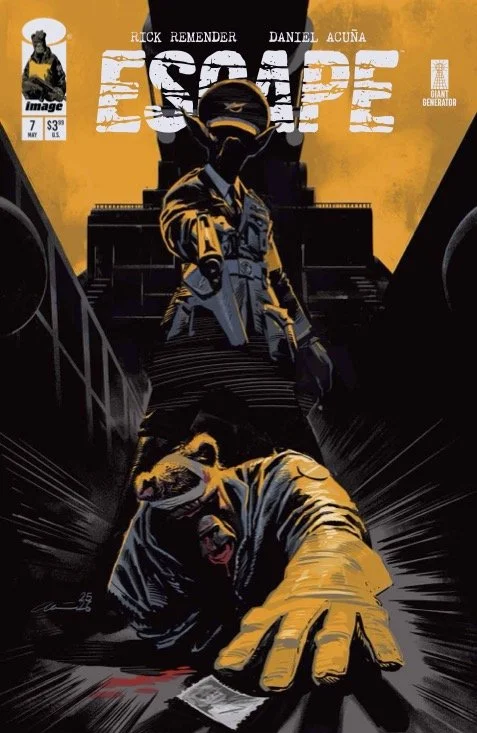
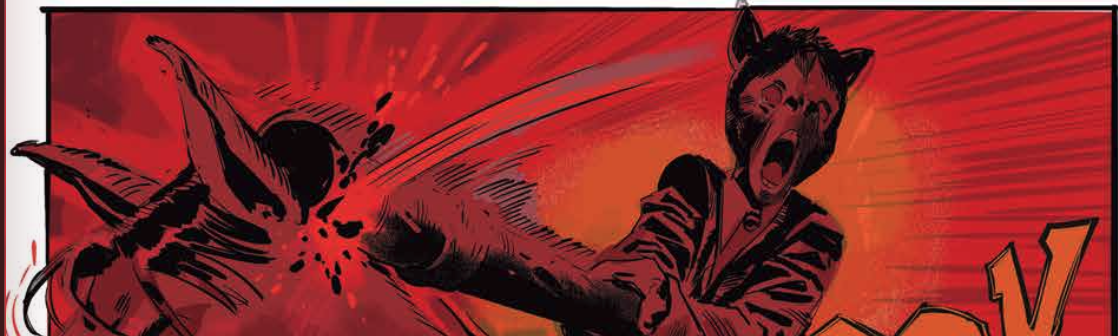
Once again: its anthropomorphized animals in a war like World War II. The amplification of different emotions and dispositions continues to carry next results in a largely well executed visual packet for the story. Acuña does a strikingly good job of illustrating tension between the characters that gradually reaches a point to which it's going to explode in physical aggression. It's actually kind of an accomplishment to be able to do this with darkly mutated cartoon animals. Any artist attempting this has to overcome the cultural baggage of light children's fare. Acuña brings it to the page and the way it feels perfectly suited to the script.
The creative team is certainly taking his time with his story. An old war comic book from the 1950s white had gotten a very similar story across and just a few pages. Writers at E.C. could occasionally be strikingly brilliant about this. However, there's something very resident in a story that gradually crawls from page to page without having to deal with the confined space of a single issue in a large anthology. Remender and Acuña maintain a tight narrative momentum, in the tenth issue.