
Moon Knight #14 // Review
Marc Spector has been many people. So has Steven Grant. So has Jake Lockley. They’ve all been so many different people over the years. And the thing is: they’re all the same guy too. And they all sit down for a little conversation in Moon Knight #14. Writer Jed MacKay takes a deep dive into a man with many personalities and many problems in “Soldier, Rich Man, Scoundrel”--a story brought to the page by artist Alessandro Cappuccio and colorist Rachelle Rosenberg. The many personalities of the knight of Khonshu have flitted around quite a lot. MacKay takes an opportunity to really nail them down in an appealing issue where the central conflict...is an inner one.
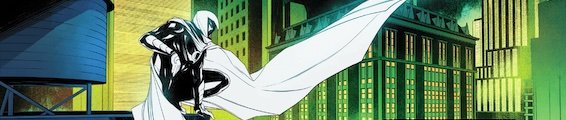
Steven Grant is trying to have a nice sit-down conversation with a few of his other personalities. He’s in a gleaming office tower high above Marvel Manhattan. At first, it appears as if Moon Knight is sitting across from him. Like it’s a job interview or something. (It isn’t.) The cabbie Lockley is phoning it in at a strip club. There’s more going on here than just that, though. Everyone involved in the conversation is aware. This might just be an intervention. Moon Knight is out of control.
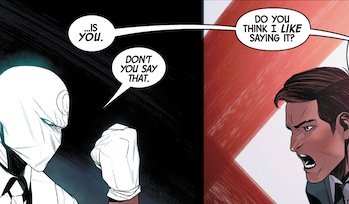
It’s been a long, slow process of getting to the heart of what makes the Moon Knight character so interesting. Co-creator Doug Moench had a very sharp idea when he made a hero and some of his informants and allies...all the same person. It was really cool. Moench never really jumped into the heart of the conflict between the different personalities...not the way MacKay is allowing himself to do in the 14th issue of the current series. This August, Moon Knight gets a firm look in the mirror in a way that he hasn’t really had much of an opportunity for in the past 40-plus years.

Cappuccio could have really tried to amplify and over-exaggerate the drama of divergent identity disorder in a way that might have caused the central drama of the issue to come crashing in on itself. To his credit, the artist maintains a sharp focus on the drama without making it seem any more fantastic than it actually is. Each of the personalities is shown in something approaching its natural habitat. The subtle drama of a conversation between drastically different people is presented in a crisp, straightforward way, with Rosenberg’s colors casting beautiful hues in between Cappuccio’s shadows.

Moon Knight works best in concert with himself. Back in the early 1980s, he was actually doing such a good job that he thought he didn’t have a mental disorder. Here things have gotten so bad that he needs to have an intervention with himself. He’s struggling with himself on so many levels that shine a spotlight on the most interesting aspect of the character: himself. The villains. The confusion. The relentless combat. None of that has ever been as interesting as the character himself. MacKay takes the opportunity to really explore him, and it works beautifully.