
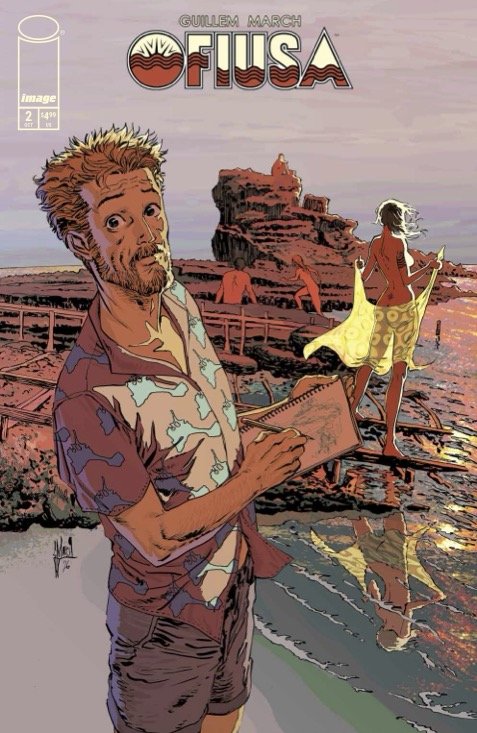
Ofiusa #2 // Revi
Madrid. Spain. He's having sex with her in a very posh apartment that overlooks the city. There is a physical intimacy and a connection being built through physical contact and a few words. There's an emotional connection. Elsewhere in another world altogether, he is having a conversation with her. She's not exactly into the whole monogamy thing. And he's just trying to relate to her. Connections make strange parallels between worlds in.Ofiusa #2. Writer/artist Guillem March continues a pseudo, romantic interpersonal drama between two people across two different worlds. There's a remarkable amount of nuance and subtlety in intimate the drama.
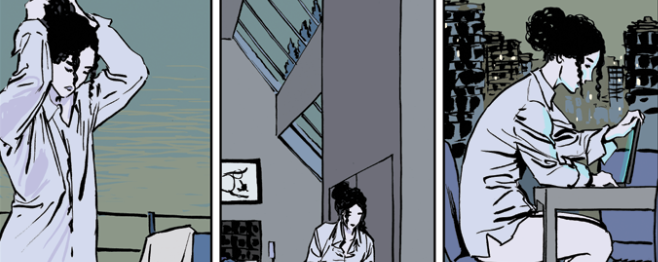
He wakes up in the middle of the night to go to the refrigerator. There she is at the table. She's writing. Not about anything recent. Writing about the past. She's not necessarily thinking in terms of sharing it with anyone else. Certainly not him. And this is the night. There's the day in another world entirely. On an island paradise. He's visiting her. He's looking at all of her art. But he's really more impressed with her. And he knows that he can't have her. Because no one can. Because she doesn't believe in monogamy. And so instead, he wants to learn how to capture her on the page. She's an artist. Maybe she could help him become an artist as well.
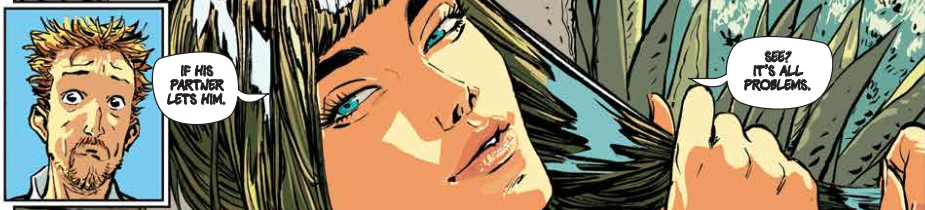
March is playing with balance. There are seems that take place at night in Madrid. There are scenes that take place during the day in the island of paradise. They are paired off against each other. And similar connections and dynamics play out between the two of them and the two different worlds. It's kind of fun to see the two contrast against each other. It would be far less interesting if March was to explore what's on the page in a different way. If he were to try to tell both stories without alternation, it would lose quite a bit. So the balance needs to be there. And the pacing is actually quite well articulated.

March is a master of subtlety and nuance. There are a lot of silent moments that play out on the page that aren't particularly revelatory. However, they do a breathtaking job of bringing across complexity of inner emotions that probably couldn't be expressed really well with dialogue or narration alone. It's a really impressive articulation between text and images that engages the deeper emotions possible between two different people and two different worlds.
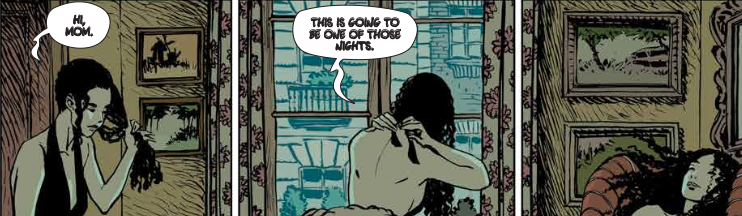
Back in the early 1970s, British fantasy author Michael Moorcock explored the nature of identity across worlds in a brilliantly overlooked, little novel called Breakfast in the Ruins. That novel was an exploration of identity as a function of chance and circumstance. It was a brilliant look into the nature of identity with respect to a single person. Ofiusa expands on the notion by focusing on two different people and two different worlds and the way chance and circumstance dictate their identities. Certain things are the same. Certain things are different. It's a very provocative and compelling idea.