

Karmen #2 // Review
A young suicidal woman has, in fact, just committed suicide. She’s having a hell of a time getting used to her new afterlife. It’s only going to get more complicated for her as she confronts harsh realities of the insubstantiality of the afterlife courtesy of her whimsical red-headed angel of death in the second issue of writer/artist Guillem March’s Karmen. The trippy journey into a world just beyond life continues in a strangely energized rush into ghost life that has some visually dazzling mutations of an authentic world. March continues to usher readers into a fun trip outside the window into the weightlessness that awaits beyond life.

She was hopelessly heartbroken. She knew her love was cheating on her, so she slashed her wrists and took a bath. Now she’s tumbling about without care for gravity--weightlessly seeing a world that is moving on without her. Her only contact with anything else is a red-headed angel of death with heavy freckles and a white skeleton visible against the pitch black of her body. The girl tumbles about, trying to make some sense of it all as her angel continues to initiate her into a world that can no longer acknowledge her.

The actual suicide at the heart of March’s story isn’t terribly interesting. That might well be the point: heartache is depressingly common. Emotions can overwhelm, and suicide can occur. March’s innovation here lies in actually showing a young woman lost in a world that she is no longer an active part of. Her impish angel is a jarring contrast from the rest of a very realistic world. There’s a strong sense of the surreal that March knows that he doesn’t have to go far to reach into the core of human emotion. In its own way, March is presenting minimalist supernatural surrealism that floats along as dreamily as its mortal female lead.
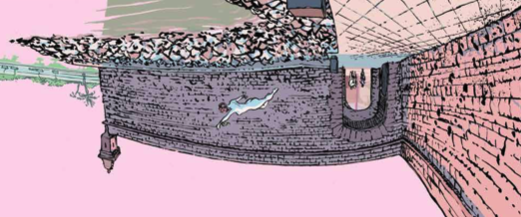
This story could be excessively dull were it not for March’s approach to the art. The architectural rendering is gorgeously detailed, warped as it is by strikingly amplified perspective and dreamily warped fisheye lens-like effects. What’s more...March’s grasp of anatomy and is deft enough to render emotional subtlety to the smallest micron. There’s incredible attention to detail in how a naked weightless body would float that goes well beyond the traditional wingless humanoid flight seen in so many other comics. A realistic body floats in a strikingly believable way through gorgeously rendered architecture. It’s beautiful stuff.

March takes his time, allowing the story to develop with short bursts of exposition shooting out of casually playful visual phantasm. There isn’t much going on here, but there doesn’t have to be. It’s just enough emotional rendering to cast a post-suicidal mood in breathtaking detail. There is a moment after a failed or abandoned attempt at suicide that feels positively serene. The living can only see that mood from the realm of the living. March casts that exact same mood quite vividly from a whimsical post-life perspective. It’s deliciously dreamy.


