

Black Widow #2 // Review
Back in the mid-1990s, writer/director Shane Black developed a clever, successful, little spy thriller called The Long Kiss Goodnight about a female super-spy who has her memory erased. She becomes a suburban housewife, but danger comes looking for her, and so she has to remember a past that she would rather forget. Writer Kelly Thompson fully brings this premise into the Marvel Universe in the second issue of the latest Black Widow series. The story is moodily brought to the page by artist Elena Casagrande. There’s more than enough here to keep Thompson’s story from feeling like an outright rip-off of Black’s as the unique personality of Natasha Romanoff defines the heart of the story.

Clint and Bucky are camped outside of a beautiful home in Sausalito. They’re watching a woman go about her life with an attractive man. These are highly-trained warriors who are ready for just about anything. What they aren’t ready for is for this particular woman to be happy in wealthy suburbia. She’s the Black Widow. She’s a super-spy. She’s...a mother. Clint swings by while she’s in the garage, but she doesn’t recognize him. She seems to have forgotten all about her life in international espionage. She seems happy. There doesn’t seem to be any danger. Should they really interfere?

Thompson constructs a totally believable alternate life for Natasha. It’s not that elements of her life as a spy aren’t present...they’re just not anything that she’s paying a hell of a lot of attention to. She gets attacked in an alley and does what comes naturally for a superhero who used to hang out with Daredevil in another life. Still, Thompson makes her stable, normal life seem compelling enough that it’s easy to see how she wouldn’t notice. Thompson strikes a clever balance for Natasha between mundane life and something more dangerous. Natasha’s toddler wittily speaks to something more. Any toddler can be found escaping a pack and play and sneaking around the house of even the most attentive parent. If that toddler happens to be the child of a super-spy, the child might take on the skill and stealth of a tiny, little ninja. Clever stuff.
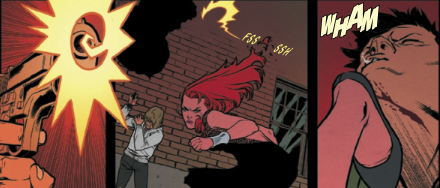
Casagrande’s layout is particularly sharp this issue. There’s a clever use of clean, expansive repetition as the script explores normally, steady everyday life for Natasha. Everything rests on the page in pretty right angles as casual conversations play out. When action hits, the page explodes. Tiny panels of action get suspended in big splashes of aggression. Violence pulls the action on the page in strange angles. Casagrande cleverly splits the visual dynamic between the steady drama of intrigue and the more jangled action of sudden bursts of violence.

The danger resting around the edges of Natasha’s life rests beneath the mystery of what happened to the Black Widow. And though this may be a very familiar premise for a story, Natasha seems to be navigating her way through it in a novel way in a distinctly Marvel application of the spy-with-amnesia sub-genre of cloak-and-dagger intrigue.


