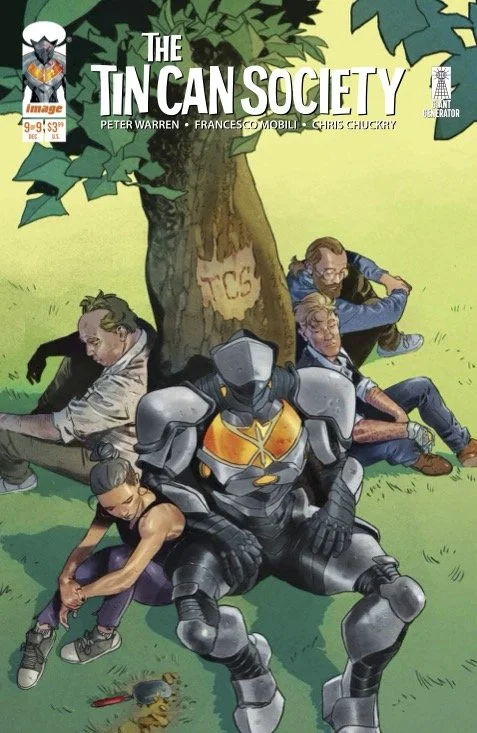

The first night that they slept together they just...slept. That was all. They slept. And the hadn’t slept at night either. They had talked until the light drained back itn the sky. Then exhaustion set in and they ended up in bed together as dawn became a reality. Things have changed since then. Dawn has become a reality in a significantly different way in Tin Can Society #3. The writing team of Rick Remender and Peter Warren continue a story that’s brought to the page by artist Francesco Mobili and colorist Chris Chuckry. There’s serious drama fitting around a variation on elements that have been found in various corners of the superhero genre for decades.

Some time later, there’s a woman pointing a gun at a couple of engineers. Things are tense. The engineers were working on something with Adam’s exotic suit of armor. They were going to figure out who killed him. Then they were going to kill them. Pretty simple revenge, really. Only that kind of revenge is, of course, totally illegal. Things are pretty intense when it’s a death-for-a-death proposition that comes into view. Things have gotten complicated. There was a mix-up. Things are getting dangerous.

Remember and Warren have a very solid piece of drama that’s being filtered through the pages in th e course of things. There’s a clever weaving of drama and silence--aggression and passion. Love and anger. It’s all there in alternating scenes that leave a lot to the imagination in and within the comings and going of the plot. There’s a hell of a lot going on in the substance of the drama that feels like it’s moving in multiple different directions. There’s a clever pulse to the alternation between aggression and love that filters its way through a very cleverly thought-out issue.

Mobili finds a way of staging the action that still manages to keep the emotional drama right at the center of everything without awkwardly amplifying everything to an awkward degree. That’s not an easy thing to accomplish, but Mobili is a master of framing everything in a way that delivers the blows with quite a bit of power without compromising the emotions that rest at the heart of the whole reason for all of the aggression to begin with. It’s all very well-executed as everyone tries to work everything ut I the midst of the uneasiness and uncertainty.

It’s not often that a story of any kind manages to render both love and aggression in equal alternating parts. It’s kind of beautiful to see it work the way it does in the third issue of Tin Can Society. All too often an issue will lean too far in one direction or the other in the course of a single issue, but Remender, Warren and Mobilli have a firn sense of precision about the balance that they are creating for the third issue of the series. It’s really impressive stuff on a few different levels.