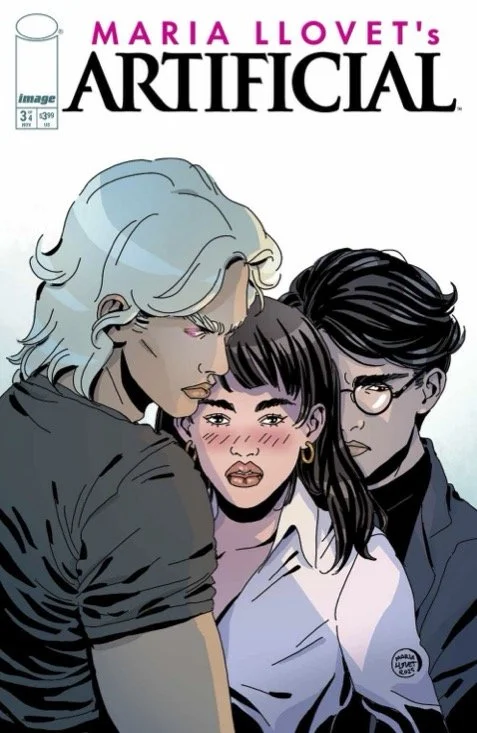
Artificial #3 // Review
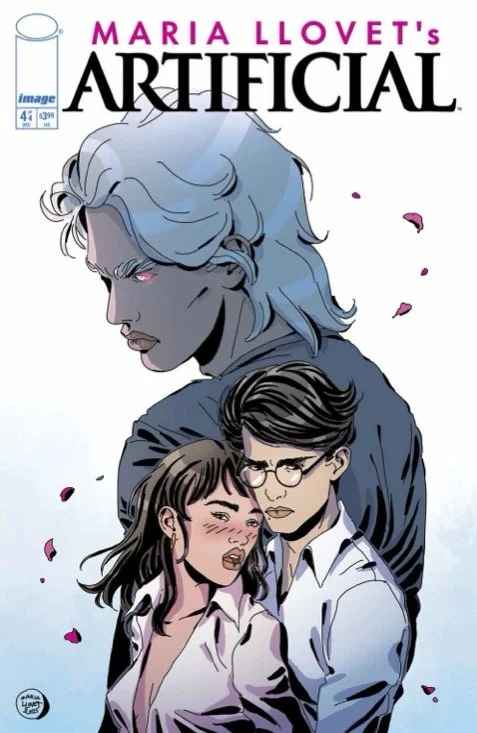
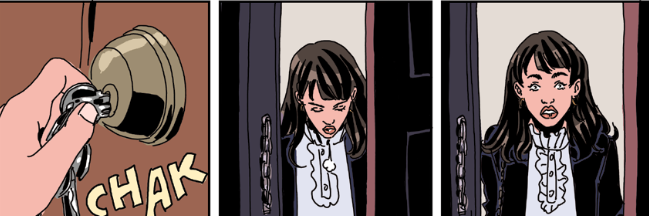
It’s a busy day for Clara. There are a million things that she needs to get through in order to be able to handle everything that she needs to be able to handle. And so naturally she just wants to relax at home and not have to worry about anything at all. When she walks through the door to find her place swimming in romantic flowers, she knows that she’s got a lot to deal with in Artificial #3. Writer/artist Maria Llovet reaches the penultimate chapter in her romantic psychological horror thriller as Clara is forced to deal with the dangers of realized fantasy.
Before she can handle anything else, she’s going to have to handle ta video call from her ex-boyfriend Mateo. To her credit, she’s totally open with him about her amorous android lover Saul. He’s jealous. He can’t compete with a man who was designed to be handsome and programmed to be so totally over-the-top romantic. She lets him know that he doesn’t HAVE to compete with Saul. No one could. He’s been programmed to BE a fantasy. Clara and Mateo seem to be making a genuine connection when Saul makes an appearance.
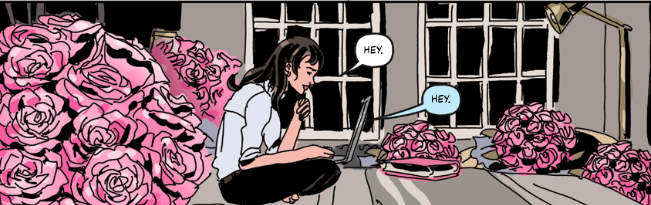
Llovett is working her way through a very impressively orchestrated love triangle. She’s developing a strikingly simple story that touches on A LOT about the nature of fantasy in a world that’s becoming increasingly artificial. It’s nothing that hasn’t been explored from a whole bunch of different angles before, but Llovett anchors her narrative very, very closely on the three central characters in a way that feels totally distinct and distinctive. The overall feel of it ends up being quite well-framed from a variety of different directions that all come together in a hauntingly simply psychological thriller for the post-modern age.
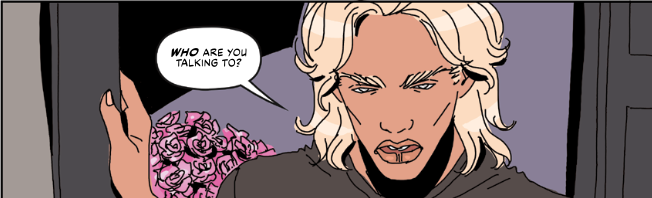
Llovet’s visuals continue to hold a great deal of approachable beauty and appeal. The casual-looking squiggles of Llovet’s line-work feel cozy enough when they’re rendering the human end of things with Clara and Mateo. It would be nice to see a colder, glossier perfection in her work whenever Saul enters the picture. The shocking contrast between the fluid, organic line work of the human end of the story could be contrasted by clean lines and perfectly composed panels with Saul. As it is, Llovet’s work seems to be humanizing EVERYTHING on the page, which does a disservice to her characterization of Saul in the script.
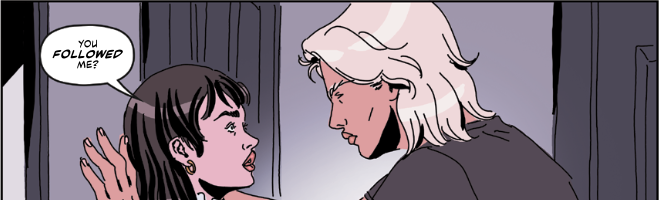
Above all, the stark simplicity of Llovet’s story is the central appeal of the whole thing.The lack of narrative flourishes around the edges of the central story keeps the focus on the love triangle in a way that keeps it all moving from beginning to end and adds to the resonance of its central conflict. The simplicity of the story is almost minimalist in its execution, which is substantially refreshing in an information-based era of popular culture in which everything has to be so totally loaded-down with detail in every way. Llovett’s work in Artificial feels romantic in form as well as fashion.